
Quick answer
Unlocking STEM potential in Cameroon's youth means widening access to tools, trained teachers, safe learning spaces and visible technical careers. Diaspora networks can help, but only when they support local educators and institutions instead of presenting themselves as the whole solution. Research checked 2026-09-03; current UNESCO, UNICEF and African Development Bank sources show momentum around digital learning, basic education support, teacher capacity and youth employability.
Barriers
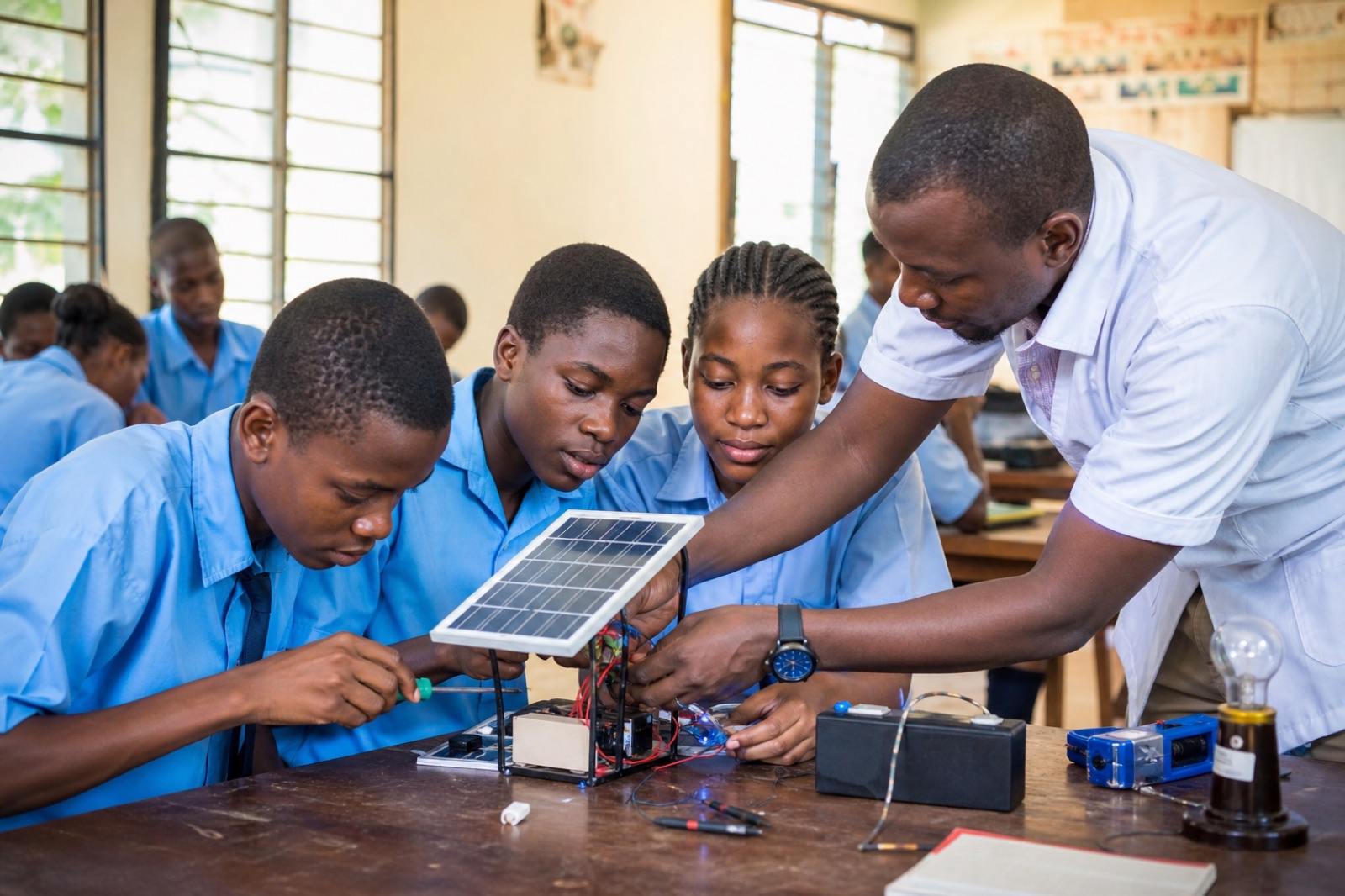
The barrier is not talent. It is uneven opportunity. UNICEF Cameroon describes education needs shaped by crisis, displacement, infrastructure gaps, gender barriers and limited digital access. Many pupils learn about technology in theory long before they can use tools directly. That matters for STEM because confidence grows through doing: measuring, building, coding, testing and correcting.
For CAMNEST-UK, this argues for targeted help. A general message about inspiration is weaker than a specific workshop, mentorship match, lab exercise, software walkthrough or teacher resource.
Digital learning
UNICEF's 2026 reporting from Limbe describes children and teachers gaining practical digital-literacy exposure through E-Container activities. UNESCO's 2026 Basic Education Support Project agreement with Cameroon includes teacher and supervisor capacity-building, digital technologies in teaching, educational resources and education-management data systems. These are system-level signals, not proof that every school has equal access.
The practical lesson is to design for mixed conditions: online and offline materials, low-bandwidth options, teacher guides and activities that work even when devices are shared.
Teachers
Teachers are the multiplier. A one-day student event can spark interest; a trained teacher can reinforce skills for years. UNICEF teacher-training stories describe educators moving from theoretical technology lessons toward practical tools for mathematics, language and creative work. For STEM outreach, teacher support should be planned as carefully as student excitement.
Diaspora role
The diaspora can add professional context that textbooks cannot: what engineers actually do, how scientists frame problems, what digital skills are used at work and how students can prepare for transitions from school to higher education or employment. This should be done humbly. Do not invent impact totals, placement outcomes or partnerships. Show the work that is documented, and name what still needs support.
Internal next steps include workshops and seminars, cloud learning platforms and mentorship.
What helps
Useful support is concrete: mentor one student, record a short technical explainer, review a project brief, sponsor shared compute, help translate a lesson into a low-bandwidth format or support teacher training. The African Development Bank's 2026 Cameroon jobs programme underscores the broader importance of employability and skills, especially in regions facing instability.
Sources consulted: UNESCO Basic Education Support Project, UNICEF digital learning story, UNICEF Cameroon education overview and African Development Bank Cameroon jobs and skills programme.
Girls and access
STEM opportunity is also a gender question. Access to devices, safe learning spaces, mentors and family support can shape whether girls stay in the pipeline. The right response is practical: visible women mentors, scheduling that respects travel and safety, beginner-friendly technical sessions and pathways that show families what STEM study can lead to.
Claims about outcomes should be documented. It is better to say what the programme offers than to invent placement numbers or success stories. Trust is stronger when evidence and aspiration are kept separate.
Measuring useful progress
Useful measures include attendance, teacher confidence, lesson reuse, student project completion, mentor retention, access to devices and transition support. Not every result needs to be dramatic. A teacher using one new digital exercise every week can matter more than a one-time showcase that photographs well and then disappears.
CAMNEST-UK can also track where support is missing: bandwidth, equipment maintenance, course materials, translation, safeguarding, transport and mentor availability. Those gaps should guide the next intervention.
Partnership discipline
External support works best when it strengthens existing schools and local leadership. Diaspora volunteers should listen first, define a narrow contribution and leave materials that can be reused. A workshop without handover is an event; a workshop with teacher notes, exercises and follow-up can become capacity.
Designing for low bandwidth
A STEM programme that depends on perfect connectivity will exclude many of the learners it wants to reach. Materials should include offline worksheets, downloadable examples, lightweight video, shared-device activities and teacher notes. Cloud tools are useful, but they need fallback paths when power, bandwidth or hardware is uneven.
This is an engineering constraint, not a reason to lower ambition. Designing within constraints is itself a STEM lesson.
Career pathways
Young people need to see more than a subject label. They need to understand what civil engineers, software developers, lab scientists, data analysts, energy technicians and product designers actually do. Mentors can translate abstract subjects into visible work: a bridge calculation, a water-quality test, a simple app, a sensor reading or a maintenance plan.
That translation helps families too. When parents understand the pathway, STEM feels less like a risky passion and more like a serious route to skill, employment and service.
Safeguarding and continuity
Programmes involving young people need safeguarding, consent, clear communications and local accountability. Diaspora volunteers should not work as isolated heroes. They should work through structured programmes with named leads, clear expectations and documented follow-up.
Continuity matters as much as inspiration. A single event can open a door; repeated mentoring, teacher support and project feedback help students walk through it.
Preparing mentors
Mentors need preparation too. A useful mentor understands the student's level, the expected time commitment, safeguarding rules and what to do when a question falls outside their expertise. Short, regular conversations often help more than rare lectures. The student should leave with a next action: a problem to solve, a resource to try or a person to contact.
For technical volunteers, humility matters. The goal is not to display expertise. The goal is to make expertise usable for the learner and reusable for the teacher.
Local ownership
The strongest programmes make local ownership visible. Teachers, school leaders and students should help choose problems, examples and follow-up tasks. A coding lesson can use local transport, water, agriculture or energy examples; an engineering challenge can use materials students recognize. Relevance makes STEM less abstract and shows that technical skill can serve communities directly.
That is the practical promise of diaspora support: not replacing local expertise, but connecting it to additional tools, mentors and routes into professional practice.
FAQ
What is the biggest STEM barrier for many pupils?
Access is uneven: tools, trained teachers, stable schooling and visible career pathways all matter.
Can diaspora mentoring replace local education systems?
No. It should support local institutions through mentoring, technical exposure and targeted resources.
Why focus on teachers?
Teacher training multiplies impact because one prepared teacher can support many cohorts over time.