
Why pilots, not mega-projects
Development engineering is littered with ambitious projects that stalled the moment external funding or attention moved on. CAMNEST-UK deliberately took the opposite path. A Pilot Engineering Scheme is a project small enough to be delivered within twelve to eighteen months and a defined budget, yet designed rigorously enough to prove — or disprove — a technical and operational model that others can replicate at scale.
The pilot format also plays to the diaspora's genuine strength. Our members cannot relocate to Cameroon to run a national infrastructure programme, but they can absolutely scope a solar micro-grid, review structural drawings, specify pump equipment, audit a budget and mentor a local site team — remotely, rigorously and on evenings and weekends.
What a scheme looks like
Each scheme starts with a proposal, usually from a Cameroonian community organisation, school or university department. Our technical committee assesses feasibility, safety and long-term maintainability before anything is approved. Every accepted scheme is then assigned a volunteer project board: a lead engineer in the relevant discipline, a finance reviewer and a local delivery partner in Cameroon who manages day-to-day works.
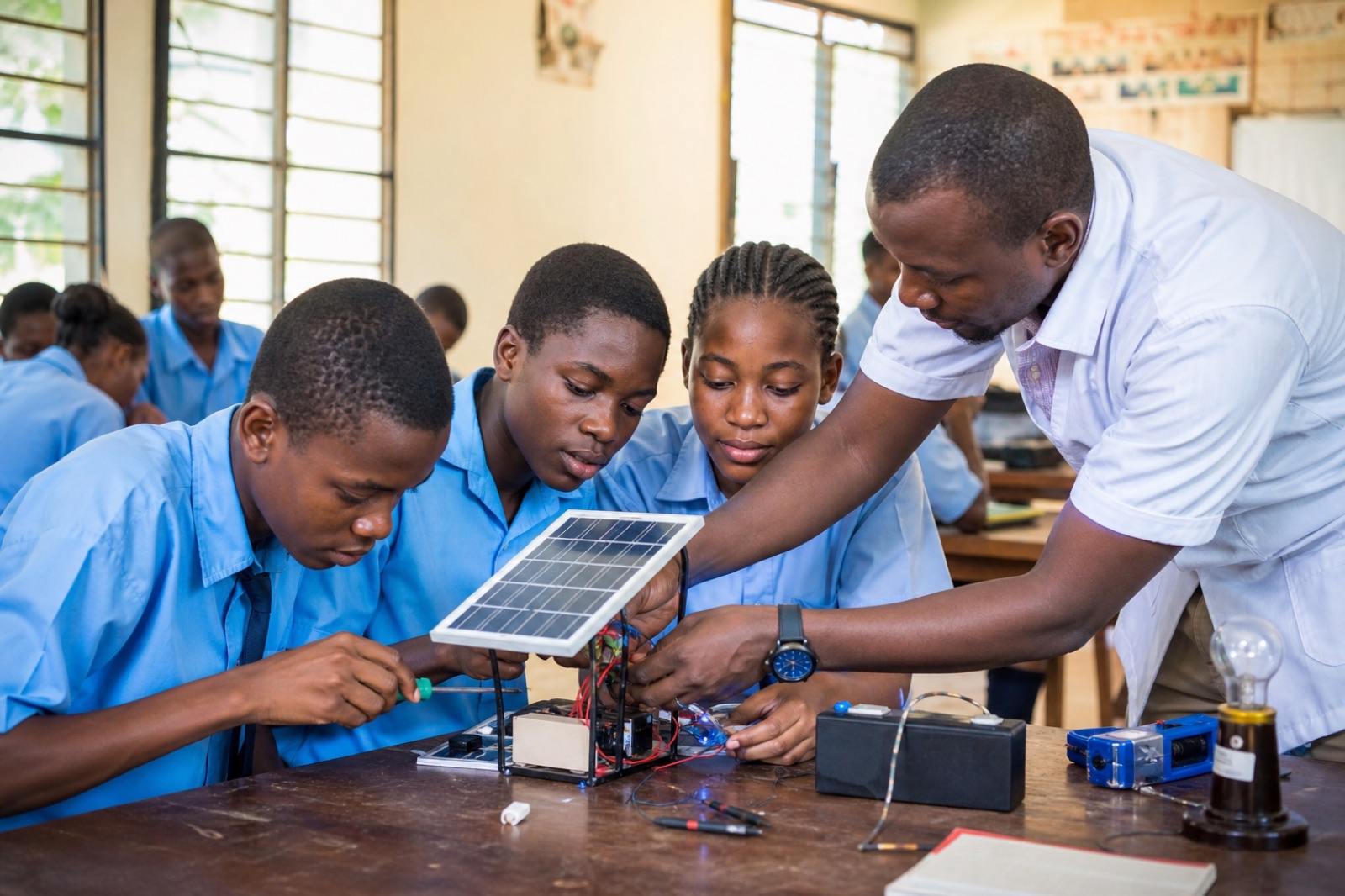
Completed schemes to date include a 12 kW solar micro-grid with battery storage powering a rural health post and adjacent school in the North-West Region; a gravity-fed clean water distribution point serving roughly 900 residents; the structural refurbishment and re-equipping of a university materials laboratory; and a workshop retrofit that gave a technical college its first functioning machine shop in a decade. Each project publishes a close-out report — costs, drawings, lessons learned — that becomes an open resource for the next team.
Engineering standards without compromise
Working at a small scale is never an excuse for lowering standards. Designs are checked against relevant British Standards and Cameroonian regulations, risk assessments are mandatory, and no scheme is signed off without a maintenance plan and a named, trained local custodian. We would rather decline a project than deliver something that fails quietly two years later — because a failed installation damages trust far more than no installation at all.
The local capacity dividend
Infrastructure is only half of the output. Every scheme is required to include a skills transfer component: local technicians are involved in installation and commissioning, operating manuals are produced in plain language, and at least one training session is delivered to the receiving community or institution. Several technicians who worked on early pilots now lead installations independently — which is precisely the multiplication effect the programme exists to create.
How members get involved
- Join a project board as lead engineer, discipline reviewer or finance monitor
- Carry out remote design reviews and calculations in your specialist field
- Mentor the local delivery team through commissioning and handover
- Help evaluate incoming proposals on the technical committee
- Sponsor a scheme through corporate membership or a directed donation
Most volunteer roles require between two and six hours per month. Members choose projects matching their discipline — civil, electrical, mechanical, water, ICT — and receive full documentation support from the programme office. For many members, a pilot scheme is the most professionally meaningful work they do all year.
Join and Support a Scheme