
The problem we set out to solve
An engineering education stands or falls on access to tools. A structural engineering student who has never run an analysis package, or a computer science graduate who has never deployed to a real server, starts their career at a serious disadvantage. In Cameroon, licence costs, ageing computer rooms and unreliable power mean that many capable students graduate without ever touching the software their profession runs on.
Physical donations — shipped computers, boxed software — age quickly and are difficult to maintain from four thousand miles away. So CAMNEST-UK's technologists asked a different question: what if the laboratory lived in the cloud, and the university only needed a browser?
What the platform provides
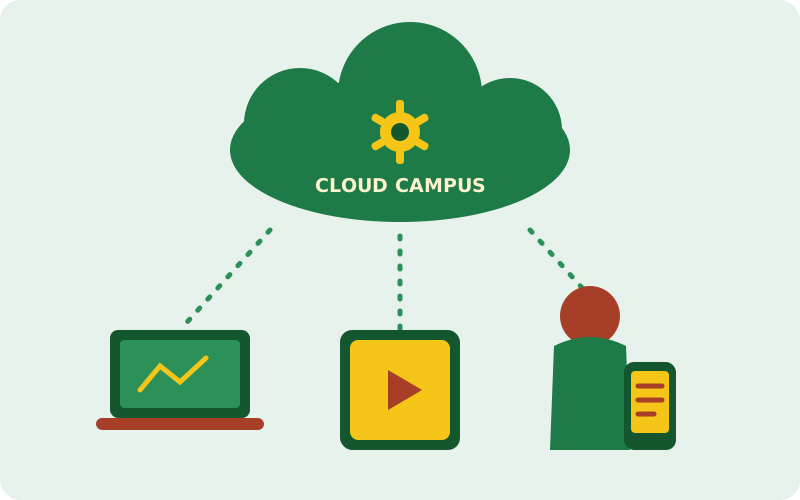
Our cloud learning environment, developed and operated by volunteer members working in software and cloud engineering, has three layers. The first is a virtual laboratory service: browser-accessible workstations pre-configured with engineering analysis tools, CAD environments, programming stacks and data science notebooks. Sessions run on cloud infrastructure funded by corporate members and grants, and are scheduled around university timetables to control cost.
The second layer is a courseware library. Every CAMNEST-UK workshop is recorded, edited and indexed, and members contribute structured short courses — from finite element fundamentals to Linux administration. Lecturers at partner universities embed this material directly into their modules, with local teaching assistants running tutorial sessions.
The third layer is low-bandwidth resilience. Everything is designed for the connectivity that actually exists, not the connectivity we wish existed: lecture recordings are available in audio-first formats, lab exercises are cached at campus edge servers, and offline work syncs when the connection returns.
Built with partner institutions, not for them
We do not parachute technology into classrooms. Each deployment starts with a memorandum of understanding with the receiving institution, a joint needs assessment, and training for local staff who administer the platform day to day. Cameroonian lecturers co-author the courseware roadmap, and student feedback drives what we build next. The result is a platform that departments treat as their own — because it is.
Results so far
The platform currently serves partner departments at four institutions in Cameroon. More than 2,300 students have completed at least one virtual lab session, and over 400 have earned course completion certificates that they cite in job and scholarship applications. Perhaps the most telling metric: exam projects at two partner departments now routinely include cloud-deployed applications and professionally produced analysis reports — work that was simply not possible before.
How you can contribute
- Cloud and DevOps engineers: help operate and harden the platform infrastructure
- Subject experts: record a short course or review courseware for accuracy
- Educators: help align material with Cameroonian curricula and accreditation
- Corporate members: sponsor compute credits, licences or connectivity
No single contribution needs to be large. A recorded ninety-minute course, a monthly infrastructure review or a modest compute sponsorship each translates directly into lab hours for students who would otherwise have none.
This programme is proof of a simple idea: knowledge transfer does not need to wait for buildings. It needs bandwidth, goodwill and engineering discipline — and the diaspora has all three.
Join and Power the Platform